
PROJECT KILLER #1
The Overscoped World
Built a 5km² map. Performance tanked. Players got lost. Lesson: Scale is the enemy of intent. Now, we build "curated density," not vast emptiness.
Raw notes, dead ends, and the physics behind the feel. This is the unfiltered log of how Playtaro games are built—layer by layer, failure by failure.
"We are now prioritizing 'feel' over 'features'. A player will forgive a missing texture faster than a sluggish jump."
Engineering Notes
Most players feel a game. They don't see the millisecond war happening between their press and the screen's response. Our 'feel-first' mandate means we budget time like a pilot, not an artist. Every frame is a 16ms container, and we meticulously allocate where that time goes.
The critical insight came from dissecting our jump mechanic in the early prototypes of Aether Drift. Playtesters consistently described the movement as "mushy" or "unresponsive," but telemetry showed input lag under the 16ms threshold. The problem wasn't speed; it was prediction. We were animating the jump arc before the physics simulation confirmed the player could actually jump, creating a visual dissonance that the brain registered as lag.
"If the visual juice contradicts the physical truth, the player will always believe the physics. Trust the simulation, then amplify it."
The solution was to re-architect the input pipeline. We separated the 'visual suggestion' from the 'simulation commit.' Now, the moment a button is pressed, a 2-frame micro-animation (a foot flex) provides immediate visual feedback, but the character's jump trajectory is locked to the physics engine's next tick. This split approach preserves responsiveness while ensuring the world remains consistent. The trade-off is a slightly more complex animation system, but the player perception of control is paramount.
A Case in Resourcefulness
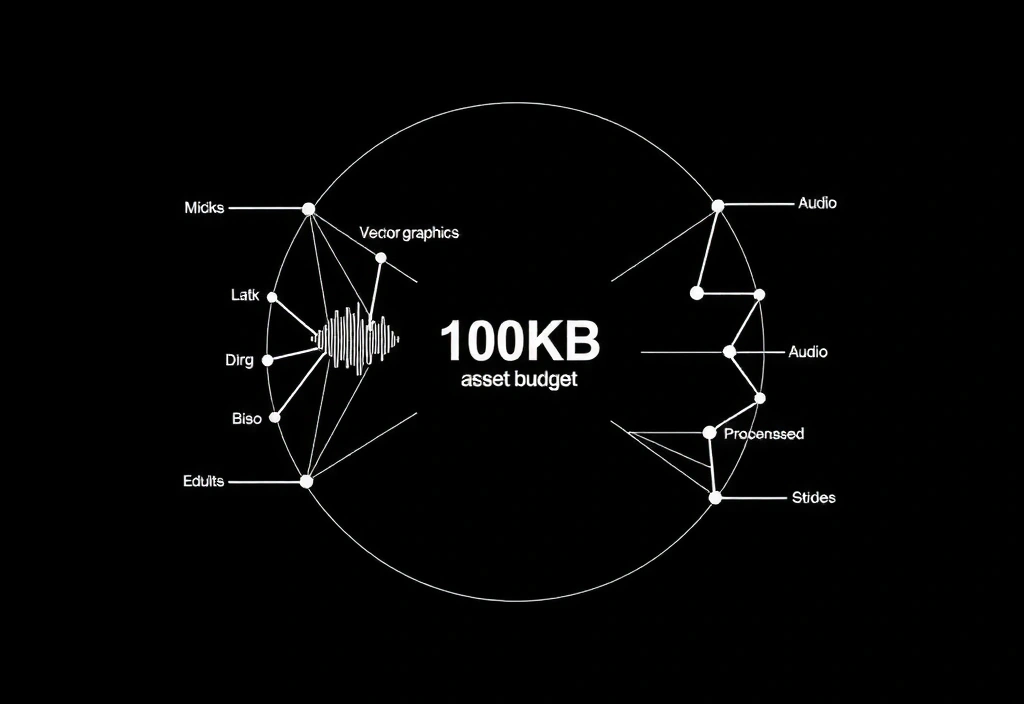
Constraints are not creative inhibitors; they are the ultimate filter for good ideas. When we entered a web-based game jam with a strict 100KB total asset budget—code, audio, textures, everything—the initial reaction was despair. The conventional answer was impossible.
Instead of scaling back ambition, we inverted the problem. We asked: "What can we create with *nothing*?" The answer shifted our entire engineering strategy. Vector art via inline SVG and CSS shapes replaced raster images. All sound effects were synthesized in real-time using the Web Audio API, with oscillators and noise nodes generating explosions, footsteps, and ambiance. Procedural generation handled levels, terrain, and even texture variations.
We built a palette of 12 core shapes. All game art—characters, environments, UI—was composed from these shapes, using transforms and gradients. This reduced our visual assets to a few KB of code.
A jump sound was a fast pitch ramp on a sine wave. A laser was a filtered square wave. We wrote a lightweight audio engine that ran on-the-fly, leaving no recorded files behind.
The psychological shift was profound. We stopped asking "What do we need?" and started asking "What is possible?" This game didn't win on polish; it won on the "Most Creative Use of Constraints" award. The skeleton we built there—component-based vector systems and procedural logic—now informs the core tech of Aether Drift.
A Chronicle of Essential Failures
Built a 5km² map. Performance tanked. Players got lost. Lesson: Scale is the enemy of intent. Now, we build "curated density," not vast emptiness.
We removed all dialogue to force "immersion." It created confusion, not quiet. Lesson: Absence needs a stronger guide. We now use environmental storytelling, not total silence.
Seven algorithms for generating "unique" terrain. Result: chaotic, unplayable noise. Lesson: Procedural is a tool, not a goal. Our systems now have strict entropy limits.
Prioritized a striking visual style from day one. It looked great, but the mechanics were an afterthought. Lesson: Build the verb first. Polish is the last layer.
The only mechanic to survive the wreckage. Its core loop of reorienting the world to solve puzzles became the seed for Aether Drift. Proof that failure is raw material.
Tested a cosmetic shop before the core loop was fun. Player backlash was immediate. Lesson: Fun builds trust; monetization is earned. The shop is dead until the game isn't.
Designing Without Words
A controlled environment with zero fail states. The player learns movement through a simple, open space. Every interactive object is a visual clue: glowing cracks teach 'breakable', moving platforms teach 'timing'.
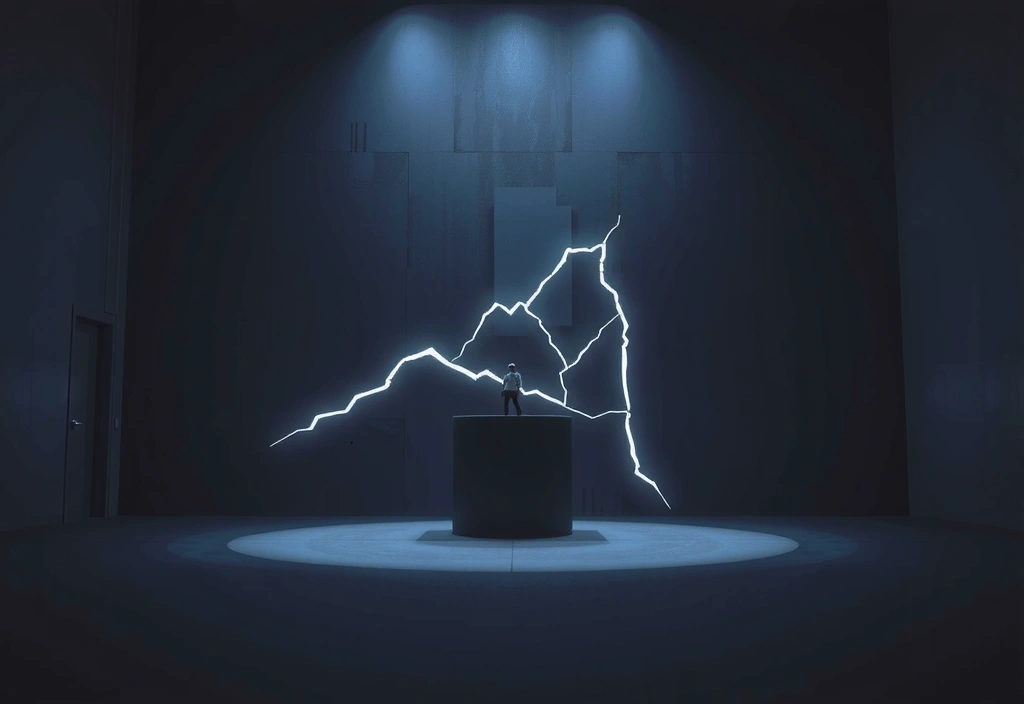
A binary path: left or right. Both lead to the next area, but one is faster. This introduces consequence without penalty. The game quietly observes the player's first agency.

The player sees a high ledge (taught earlier) and a movable object (taught earlier). They combine them. A small, satisfying audio-visual reward triggers. The core loop is now physically understood.
"If you need a pop-up to explain a mechanic, you've already failed."
Internal Pitch Deck v1.2
A gravity-flipping exploration game set in the ruins of a celestial library, where every artifact holds a memory and the world itself is the puzzle.
Players who loved the environmental storytelling of Outer Wilds and the spatial puzzles of Fez, but seek a more meditative, less punitive experience.





A growing audience craves contemplative, non-violent experiences. We offer a focused, physics-driven narrative where the challenge is observation, not combat.
This journal is just a snapshot. Explore our full development methodology, from concept to launch, and see how we turn constraints into compelling games.
View Process & Methodology